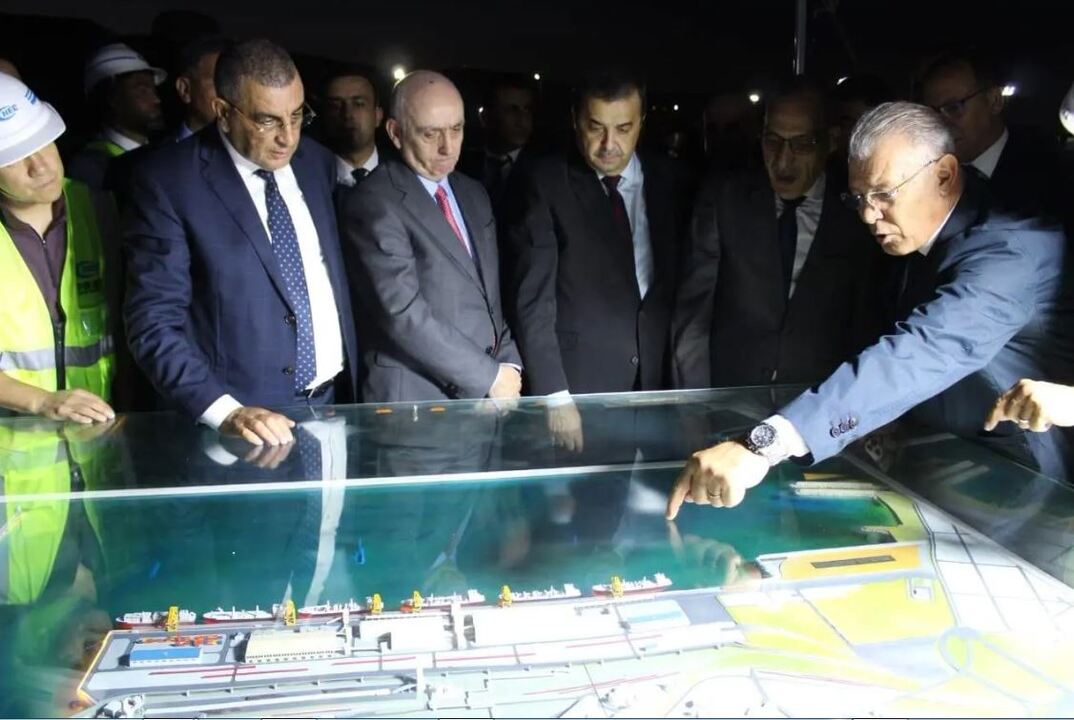
Sines, Portugal, Spt. 24, 2026 (Lusa) - Environmental NGO Zero said Thursday that the new General Cargo Quay at the Porto de Sines, designed for both civilian and military use, should prioritise the energy transition and offshore wind power.
The new quay at the Alentejo port, in the district of Setúbal, managed by the Sines and Algarve Ports Authority (APS), could be «a key piece of infrastructure for the energy transition» and «the creation of a value chain» linked to «offshore wind power», the association stated in a press release.
However, it added that the Environmental Impact Assessment (EIA) for the New General Cargo Quay, which was open for public consultation until 9 September, «still needs to demonstrate that this will in fact be the priority use of the infrastructure».
The study, seen by the Lusa news agency, states that the infrastructure must meet both civil and military usage requirements.
According to Zero, the EIA «acknowledges that the end use» of the future quay «remains to be defined, whilst allowing for activities linked to offshore renewables, agri-food bulk goods, RO-RO operations involving cars, and dual civil and military use».
For the organisation, «this lack of definition is crucial», given that «a port infrastructure designed to remain in operation for many decades cannot be assessed as if all possible uses had the same impacts».
In the environmental association's view, the new quay has «features suited to offshore wind power», namely its «high cargo capacity, large embankment areas and rail access».
«These conditions should be utilised to develop industrial capacity in Portugal, including assembly, component integration, maintenance, repair, specialised logistics and engineering,» it said.
This approach will help Portugal maximise its contribution by offering more than just a port, land, and energy for the simple transhipment of equipment produced far from the locations where it will be installed.
«This approach must be coordinated with the Offshore Renewable Energy Allocation Plan (PAER), the planning of future industrial acceleration zones, the electricity grid and public instruments for financing and promoting the energy transition,» the statement reads.
Whilst considering «the plan for a new railway branch line directly linked to the quay to be positive», the association noted that «electrification and storage remain insufficiently defined».
The project «still has an opportunity to present an integrated electrification strategy for the terminal and a storage system designed to manage power peaks, integrate local renewable generation, and provide system services», it argued.
Given the current climate context, the new port infrastructure must be prepared «to operate with electric machinery, local renewable energy generation and energy management and storage systems», thereby reducing dependence on fossil fuels.
In the statement, Zero also highlights the importance of thoroughly assessing the climate and cumulative impacts of the new quay and the extension of the East Jetty, which was also subject to public consultation.
Regarding the breakwater, Zero acknowledged a favourable Environmental Impact Statement, contingent on adopting lower-emission alternatives, adjusting material quantities and monitoring and offsetting the loss of marine habitats.
The environmentalists also considered «an integrated assessment of the new quay and the extension of the East Breakwater to be essential».
«The formal separation of the procedures must not lead to an underestimation of the cumulative impacts on marine habitats, hydrodynamics, material consumption, emissions and the landscape,» it warned.
Zero explained that it «does not reject the creation of new port capacity in Sines», but maintained that the project's «environmental justification» «depends on the use» the new quay will serve.
HYN/ADB // ADB.
Lusa