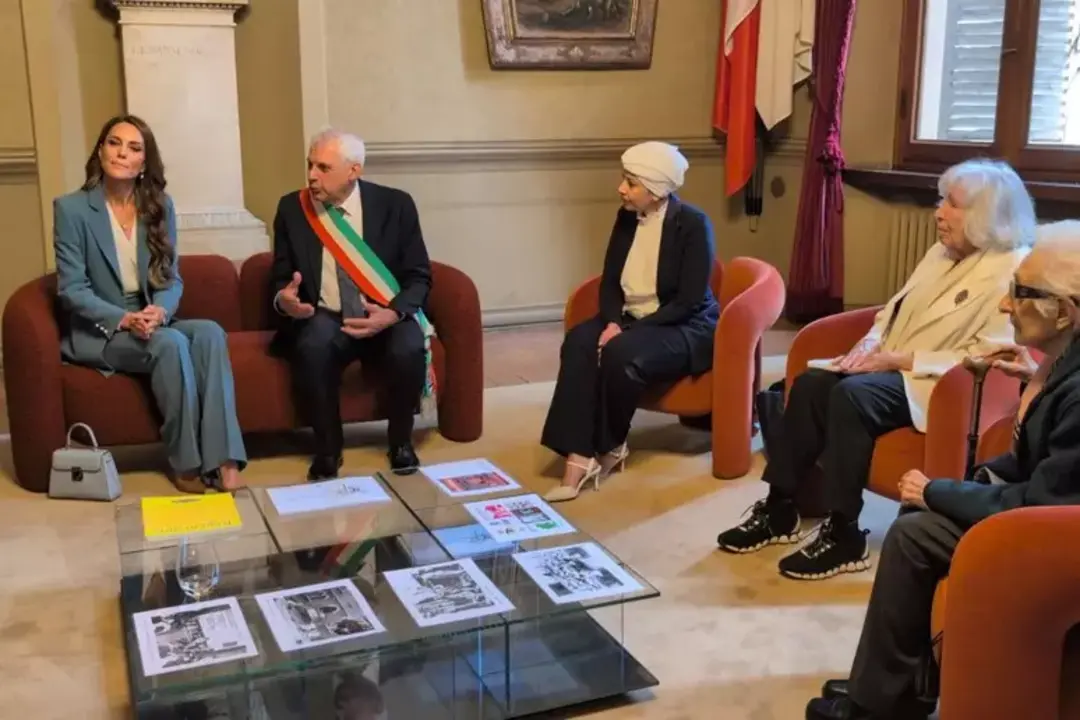
Princess of Wales Catherine 'Kate' Middleton on Monday met some pioneers of the world-leading Reggio Approach to early education and child development on her historic visit to the Emilian city.
Kate, who has three children with husband Prince William of Wales, met three women who invented and first employed the approach as she delved into it on behalf of her own early education foundation which she founded five years ago.
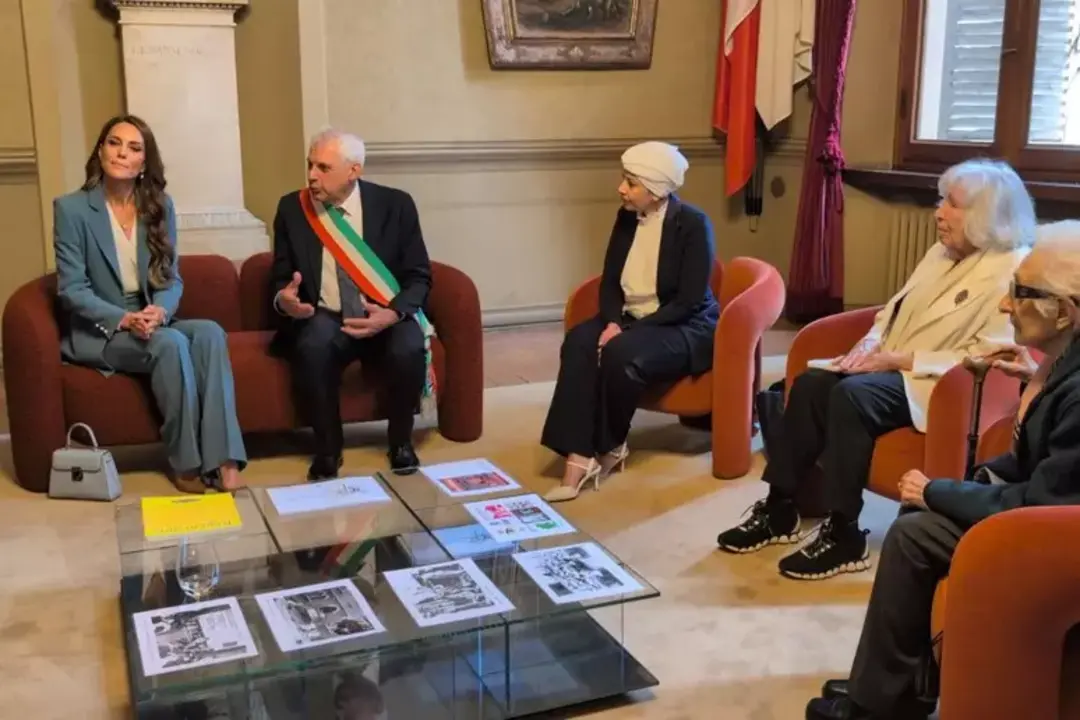
"Children are important not only for the future, but also and above all in the present," as "bearers of rights," said one of the three, Ione Bartoli, in her conversation with Kate in the Sala Rossa (Red Room) of Reggio Emilia's City Hall, along with Carla Moroni and Eletta Bertani, two other "historical" figures in Reggio Emilia's educational philosophy.
The princess asked them why children are so important, and how they are specifically placed at the centre of this, which is not just a simple method, but a broader approach.
Accompanied by Mayor Marco Massari and Councilor for Education Mahmoud Marwa, the three women recounted the early days of the Reggio Approach, aided by an interpreter.
Ione Bartoli was among the women who, after the war, as soon as the Germans were driven out, decided, together with the town assemblies, to use the proceeds from the piecemeal sale of an abandoned German tank to build not a theatre, not another structure, but a kindergarten.
The XXV Aprile school was born.
"Everything was missing," Ione emphasized, "even a piece of nail was precious." "That kindergarten was built by the citizens.
Those who were skilled in trades built it physically. To keep it afloat, peasant women were asked to bring eggs and flour so they could prepare a hot meal for the children at least during the day." The school still exists.
It is the school that the father of the Reggio Approach, Loris Malaguzzi, an educator, reached by bike.
And from there, it all began.
Kate was deeply moved to hear how people gave up everything, even the little they had, to build a school.
"Our concept", Ione emphasized, "is that when a child is born, a citizen is born. A person who has the right to become, who must be respected." Kate's visit to Reggio on Wednesday and Thursday is her first public engagement abroad since her tough fight with cancer she faced in 2024, which resulted in the announcement of remission following extensive, intensive chemotherapy.
In 2024, William and Kate had planned a visit to Italy, which they were then forced to postpone due to the princess's health issues.
This ordeal now appears to be behind them, several commentators have pointed out, presenting the mission to Reggio Emilia as "a return" to the international stage.
Kate's last foreign mission as a member of the royal family dates back to December 2022, when, three months after the death of Queen Elizabeth II, she accompanied William to Boston, USA.
In April 2025, Italy was the scene of a state visit by King Charles and Queen Camilla, who, after institutional meetings in Rome, also stopped in Ravenna and in Emilia-Romagna.
Reggio Children, an organisation that runs the Reggio Emilia Approach to early education in which the princess has voiced great interest, said her visit would be "an opportunity for authentic discussion".
Reggio Children is the international center for the defense and promotion of the rights and potential of children, founded in 1994 to enhance and strengthen the experience of Reggio Emilia's municipal schools and infant-toddler centers.
The pedagogical approach known worldwide as the "Reggio Emilia Approach," is based on listening, creativity, and the uniqueness of children's "hundred languages." "What built the Royal Foundation Centre for Early Childhood—restoring the emotional and relational dimension of childhood to its rightful centrality—deeply resonates with what this city has practiced for decades in its schools and what Reggio Children brings to the world," emphasized President Maddalena Tedeschi.
"Reggio Children's mandate," she explained, "is born from a conviction that is first and foremost political: boys and girls are subjects of rights, bearers of thought and multiple languages." Tedeschi recalled the founding figure of the Reggio Emilia Approach, pedagogue Malaguzzi.
He, the president emphasized, "envisioned the International Center that bears his name as a gulf: a place of arrival and exchange, not an archive of pre-existing answers. It is in this spirit that we welcome those who come here seeking something—not to export a model, but to open a dialogue." "Knowing that the Princess of Wales, through the Royal Foundation and Reggio Children, has taken an interest in the Reggio Emilia Approach and our public schools in the municipality of Reggio Emilia shows how much progress has been made since the post-war period, from the first self-managed preschools in the 1950s to 2026," added Federico Ruozzi, president of the Schools and Nursery Schools Institution.
ALL RIGHTS RESERVED © Copyright ANSA