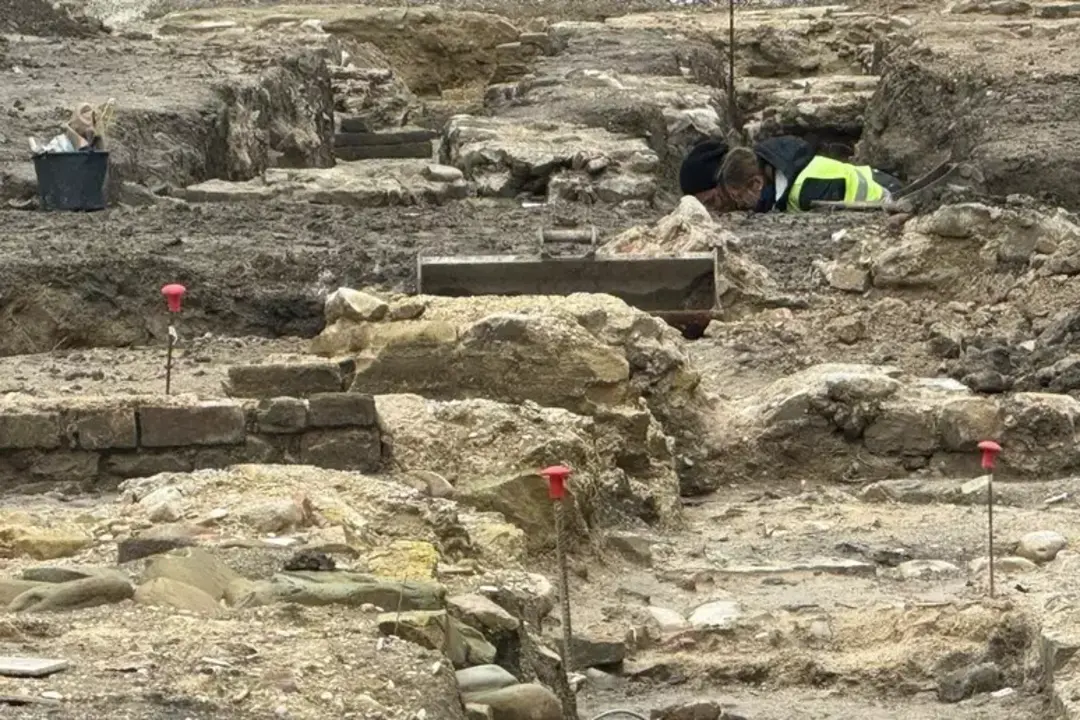
Archaeologists have found the remains of the fabled basilica of seminal ancient Roman architect Vitruvus in a discovery that Italy's culture minister said was "the Tutankhamun of the 21st century".
The building designed by the master builder whose iconic proportional tenets were celebrated in Leonardo da Vinci's totemic Vitruvian Man was unearthed during excavations in the Marche city of Fano, Italian officials said Monday.
The basilica, built at Fanum Fortunae and completed in 19 BC, is the only building scholars know that first-century BC Roman architect Vitruvius worked on because he referred to it specifically.
The building disappeared over time and its precise location had become a mystery.
Vitruvius' De architectura is the only treatise on architecture to survive from antiquity and is regarded the first book on architectural theory.
"For more than 2,000 years we have been waiting for this discovery," said Fano Mayor Luca Serfilippi as he presented the breakthrough at a conference featuring Culture Minister Alessandro Giuli via video link.
"We have found the Basilica of Vitruvius.
"I am proud of the work done".
Giuli, the culture minister, said "this remarkable discovery truly represents something exceptional in the history of archaeology, architecture, and the morphology of the city of Fano, whose enormous importance we had already recognized." Giuli spoke in a video link to the presentation press conference, which was attended, among others, by Mayor Serfilippi, Marche Governor Francesco Acquaroli, and the Superintendent of Archaeology, Fine Arts, and Landscape for the provinces of Ancona and Pesaro Urbino, Andrea Pessina.
The minister drew a parallel with Tutankhamun's tomb, called the discovery of the century in the 20th century, and also cited the discovery of the Lapis Niger in Rome, "the most important monument in the Roman Forum, with a block bearing the inscription 'Re', a datable proof of the existence of the Royal Age." "The exact same thing has happened in Fano in archaeology and research," Giuli stated.
"At this precise moment in our lives," history "is divided between before the discovery of the Basilica of Vitruvius and after the discovery of the Basilica of Vitruvius.
"History books, not just our talented journalists," he said during his video address, "will report and historicize this day and everything that will be discovered and written about this exceptional discovery from now until the next few years." Giuli went on: "The royal age in Rome is proved to have existed because we discovered, at the end of the 19th century, precisely through Carandini's excavations, the material evidence demonstrating that there were kings in Rome in the 8th century BC.
The same thing is happening now." "Until now," the minister added, "we only had written knowledge of the sources; we had Palladio and others who worked on Vitruvius's great work.
"Now we have the contextual data, such as having discovered Pythagoras's school in Crotone," he emphasized, "because according to Pythagoras, cited by Vitruvius, numbers and their ratios have a spatial configuration." "Today we have discovered the spatial configuration theorized by Pythagoras, realized and canonized by Vitruvius," Giuli continued.
"Today they are the epicenter of a sensational discovery that will allow the scientific community, historians and others, to reframe a piece of history, of urban planning history from ancient to contemporary." "Therefore," the minister reiterated, "it is something our grandchildren will talk about.
And if Leonardo was able to create the Vitruvian Man now in Venice, at the Gallerie dell'Accademia, thanks to Vitruvius's studies, grounded in Pythagoreanism, today the citizens of Fano are living, breathing Vitruvian Men, because they have found in the site of the Vitruvian Basilica a mirror of their identity, which is the identity of Italy, of the deepest Italy, of the most ancient Italy, which will become and already is the identity of Europe, the West, and the world." "Leonardo da Vinci," Giuli continued, "designed it in all its perfection thanks to Vitruvius. Today, its plastic and architectural perfection is before your eyes, and I hope very soon before mine as well. And it is in the spotlight of the entire world." "This discovery marks a before and after," he reiterated.
"And in the coming months and years, we will realize the importance of this extraordinary find and, at the same time, a renewed public awareness of the importance of protection, conservation, and archaeological research in places like Fano, whose sources attested to its great importance, and whose material discoveries today confirm its centrality in the history of world culture." "Today," Fano Mayor Serfilippi emphasized, "we are truly projecting ourselves into a global dynamic.
"Vitruvius was truly the founder of architecture; he cites Fano in 'De Architettura,'" he recalled, "and now finally the discovery, after 500 years of searching for him by scientists, scholars, and archaeologists. "Thanks to the work with the Superintendency, then the Ministry, and the Marche Region, I am confident that together we will promote this important figure." "The excavation area will undoubtedly expand, that's for sure," the mayor observed, "in the sense that we will need to find the resources to deepen the excavations together with the Superintendency, the Ministry, the Marche Region, and anyone who wants to help us." "We," Serfilippi continued, "have an active Vitruvian Study Center, which for over 30 years has been working hard to promote the figure of Vitruvius, so today I think it is a great source of pride, not only for them, but also for our city." Meanwhile, excavation work continues.
"We will certainly establish a technical committee now," the mayor announced, "and then we will move forward with the excavations and properly valorize the finds that have been uncovered."
ALL RIGHTS RESERVED © Copyright ANSA