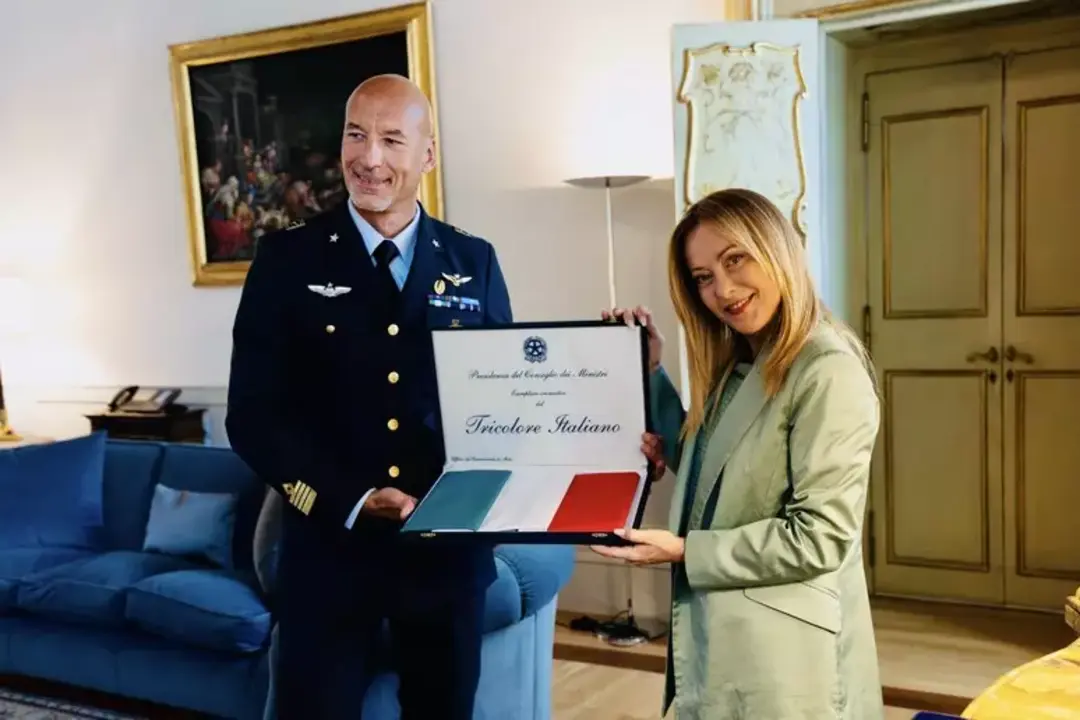
Premier Giorgia Meloni on Wednesday received astronaut Luca Parmitano at her office at Palazzo Chigi and gave him the official Tricolour flag of the Italian State to take with him on the Artemis III mission.
Last month NASA announced that Italian Air Force colonel Parmitano would be the pilot of the mission, which is scheduled for the second half of 2027 with the aim of paving the way for humanity's return to the Moon.
A statement said Meloni congratulated Parmitano on landing an assignment "which brings honour to the entire nation and confirms, once again, Italy's excellence in the space sector".
It said she gave Parmitano the flag as a "symbol of Italian ingenuity, identity, and pride".
"We are very proud and very curious," Meloni said as she gave him the flag.
"Not many deserve it like you".
Parmitano, who was accompanied by his wife, revealed some details about the mission before receiving the flag.
"It is a one-of-a-kind mission; it echoes what happened with Apollo 9—though that was the ninth mission," he said.
"For us, it is the third—the second with a crew—and the very first where we will test the systems essential for the Moon.
"It is a mission dedicated entirely to experimentation and testing....
"We will perform rendezvous manoeuvres—orbital manoeuvres, including manual ones—where we will pilot the spacecraft close to the lander, dock with it, and allow the astronauts to transfer from one spacecraft to the other; afterwards, we will undock, fly around the lander to verify that everything went smoothly, and then move away.
"The first lander will burn up in the atmosphere; another one will launch, and we will repeat the same manoeuvres but using different procedures—since the two landers are very different.
"It is an extremely complex mission, because while the first one—Artemis II, which recently landed and was highly successful—involved just one spacecraft and a relatively simple mission profile, we have three spacecraft, three control centres, and three ground crews that must all work together in a coordinated way to ensure the success of our manoeuvrers and our mission.
"From Monday I'll problem be strapped tight into the spacecraft seat, learning everything down to the last bolt." The 49-year-old from Paterno in Sicily was selected as an ESA astronaut in May 2009.
He has had two stints in space and during the second, in 2019, he became the first Italian to command the International Space Station.
ALL RIGHTS RESERVED © Copyright ANSA