From the first female mayors elected in 1946 to the recent passage of a law introducing the separate crime of femicide.
Eighty years of battles, social transformations, and legislative achievements have changed Italy, though still not enough, because the road to real equality remains long and strewn with obstacles.
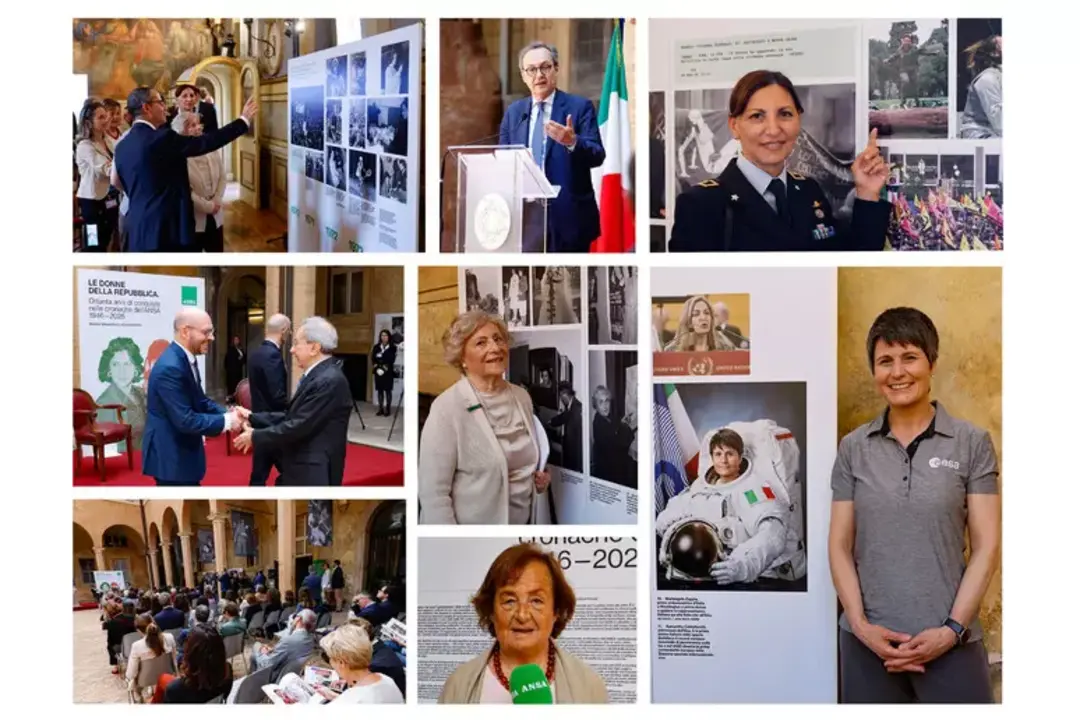
This was the thrust of the opening remarks at the inauguration of the exhibition "Women of the Republic.
Eighty Years of Achievements in the ANSA Chronicles. 1946 - 2026," which can be visited free of charge until June 30th at the Vicolo Valdina Complex, Piazza Campo Marzio 42, Rome.
From July 1st, it will be hosted at the Auditorium Parco della Musica Ennio Morricone, and a selection of photographs will be projected onto numerous buildings across Italy on June 2nd.
A tribute from the agency, on the occasion of the 80th anniversary of the Republic, to the commitment of 135 women, just a sample of the army of citizens who fought for equal rights in the decades following the referendum.
Some 122 photographs capture the arduous journey they had to travel, described in the opening ceremony by three of the women represented in the exhibition: Samantha Cristoforetti, the first Italian woman to fly in space; Rosa Oliva, whose appeal to the Constitutional Court paved the way for women to advance in high-level public administration; and Debora Corbi, Italy's first female soldier.
"Since 1946, women's presence in society has seen significant progress, accompanied by profound cultural and lifestyle transformations," said Chamber of Deputies Speaker Lorenzo Fontana in his opening remarks.
He also emphasized that "inequalities and discrimination persist in everyday life, and the serious and unacceptable violence against women in its many forms continues to weigh heavily.
"Initiatives like this therefore take on an even deeper meaning.
They don't simply recount the past, but remind institutions, politicians, and all of us of a specific responsibility: to fully and concretely implement the principle of gender equality in every aspect of life." ANSA President Giulio Anselmi also emphasized that this is still an incomplete journey.
"Let's be careful not to exaggerate with triumphalism," he warned, "considering that the reforms are a first step that many still need to follow.
"Only a little over half of women today have stable employment, while seven out of ten men do." Anselmi also noted that the introduction of the crime of femicide "is certainly important in this process," but "femicides have not decreased and are one of the scourges of this country." ANSA CEO Stefano De Alessandri emphasized the agency's role, which "for 80 years has been committed every day to reporting and documenting the evolution of this issue with the aim of informing, sharing, and promoting culture.
"It's a commitment," he continued, "that the agency also carries forward internally as a company, and which recently received formal recognition with the achievement of certification for gender equality and inclusion.
"We were among the first in our sector to achieve this, and we hope to be an inspiration to everyone.
"Today, perhaps some achievements are taken for granted, but these women were protagonists of change," said Editor-in-Chief Luigi Contu.
"From the first female mayor of a small Sardinian village, to the first municipal cleaner, to the first female bus driver, to the first female miner in Sulcis, you'll find figures who were previously unknown but who later became part of our history.
"Every time a law was passed or one of these people achieved a certain result, there was an ANSA journalist or photographer to witness it." Cristoforetti, Oliva, and Corbi visited the exhibition, stopping to admire the portraits of the well-known and lesser-known women who have, however, shaped the country's history, and having their portraits immortalized.
"I never saw becoming the first female astronaut as a goal," Cristoforetti said.
"I just wanted to become an astronaut, but I definitely felt strongly that it had an impact, precisely because of the disruptive and symbolic power of space, which I think is also why my image was chosen." "I have some things in common with Samantha Cristoforetti and Rosa Oliva," Corbi emphasized.
"We share dreams and hopes. In the 1990s, I was an ordinary girl who had a special and seemingly unattainable dream: to wear the uniform. I take this opportunity to thank ANSA because at the time, the media were our allies." "It's a wonderful feeling," Oliva said.
"It's important that women and men, and especially girls and boys, are aware of how long and arduous the journey that led to substantial freedom was, a freedom enshrined in Article 3 of the Constitution and how the road to equality is still strewn with obstacles and risks, because Italy's position in the world is not optimal.
"They tell us that it will take five generations for real equality, therefore an infinite time." The exhibition, which was sponsored by the Ministry of Foreign Affairs and the National Association of Italian Municipalities (ANCI), was created in collaboration with the Cinecittà archives and the Istituto Luce photo archive.
ALL RIGHTS RESERVED © Copyright ANSA