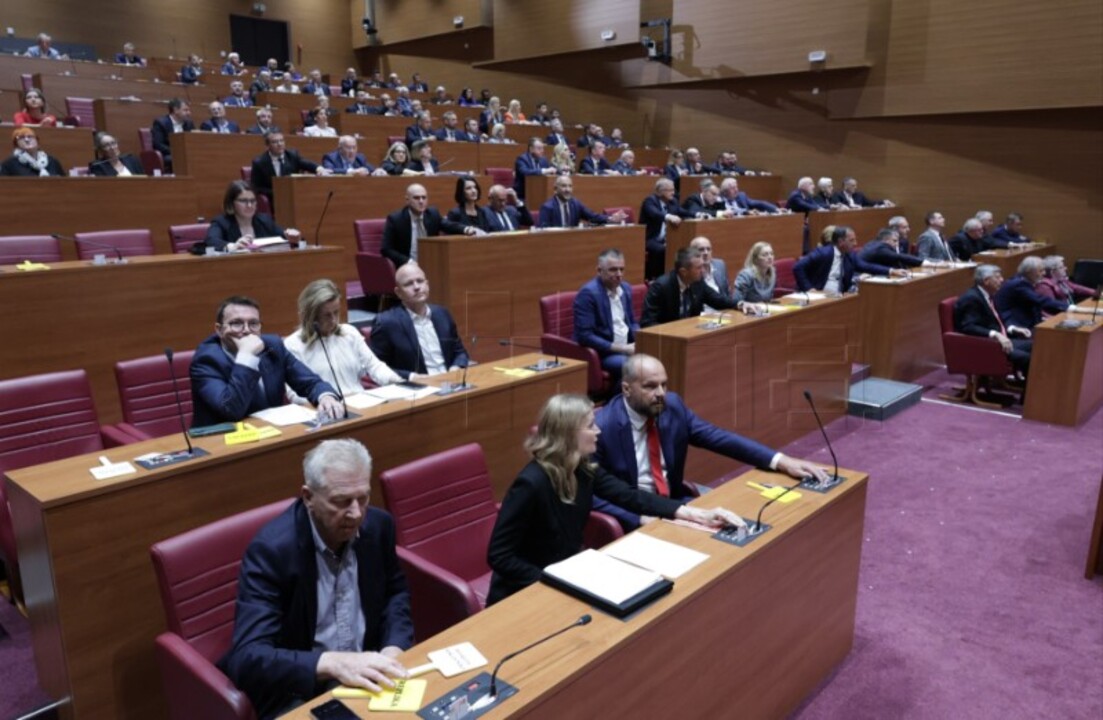
ZAGREB, 16 May (Hina) - The Croatian Parliament amended the Foreigners Act on Friday, under which foreign nationals living and working in Croatia will have to pass a Croatian language and Latin script exam at the A1.1 level within one year, as a condition for extending their residence and work permits.
The law was supported by 80 MPs, while 37 abstained and none voted against it.
The law allows foreign workers to change employers after six months of work without needing a new residence and work permit. The permitted period of unemployment for foreign workers during the validity of their permit has also been extended to three months, or up to six months if they have held the permit for more than two years.
Professional truck and bus drivers who are citizens of third countries may be issued a long-term visa valid for up to one year, which will be revoked if used contrary to its intended purpose.
A foreign worker who has been issued a permit for a shortage occupation will no longer be allowed to work in areas where that occupation is not considered a shortage occupation, or in areas where a labour market test has not been conducted.
A permit for seasonal work, which until now was issued for up to one year, will now be valid for three years if it concerns the same foreign worker and the same employer. With this permit, the seasonal worker may work up to 90 days in a calendar year or up to nine months annually. The deadline for processing permit applications is extended to 90 days.
The obligation to notify the police about the termination of an employment contract will no longer fall on the foreign national, but on the employer, who must do so electronically through the e-Građani system. The foreign worker will have to notify the Croatian Employment Service (HZZ) within five days of the termination of the employment contract. If the worker refuses a job offered by the HZZ, they lose their permit.
For the purpose of studying, temporary residence permits for foreign students are extended to up to three years.
Parliament also amended, under fast-track procedure, the Croatian Bank for Reconstruction and Development (HBOR) Act, more clearly defining the legal status, ownership and management structure, organisation, goals and tasks of that financial instrument of strategic importance for Croatia.
In addition to its existing activities, such as financing infrastructure development, promoting exports and supporting the development of small and medium-sized enterprises, new activities are being added, including promoting a climate-neutral sustainable economy, supporting the development of the capital market, and participating in the implementation of international development cooperation.
The law stipulates an increase in the bank’s share capital from the current €929 million to €1.91 billion, an increase of €981 million. The increase is planned to be financed through the National Recovery and Resilience Plan in the amount of €410 million, while the remaining €571 million will come from HBOR’s retained earnings and reserves.
The law also increases the number of members of the Supervisory Board to 12, eight of whom will be ministers. Three members will represent the Croatian Parliament, while the remaining member will be the president of the Croatian Chamber of Economy.
Development of nuclear energy for civilian purposes
Parliament also adopted the Development of Nuclear Energy for Civilian Purposes Act, intended to establish a stable, transparent and modern framework for the development of nuclear energy in line with European climate goals.
The aim of the law is to ensure stable and secure energy supply, achieve greenhouse gas emission reduction targets and fulfill Croatia’s obligation to develop knowledge, regulatory capacities and professional oversight over technologies already used or rapidly developing in Europe and around the world.
The law also stipulates that the strategic planning document, namely the Programme for the Development of Nuclear Energy for Civilian Purposes, will be adopted by Parliament upon proposal by the government.
A set of judicial laws, concerning the Judicial Academy, the State Judicial Council and the State Attorney’s Council, was sent to a second parliamentary reading.