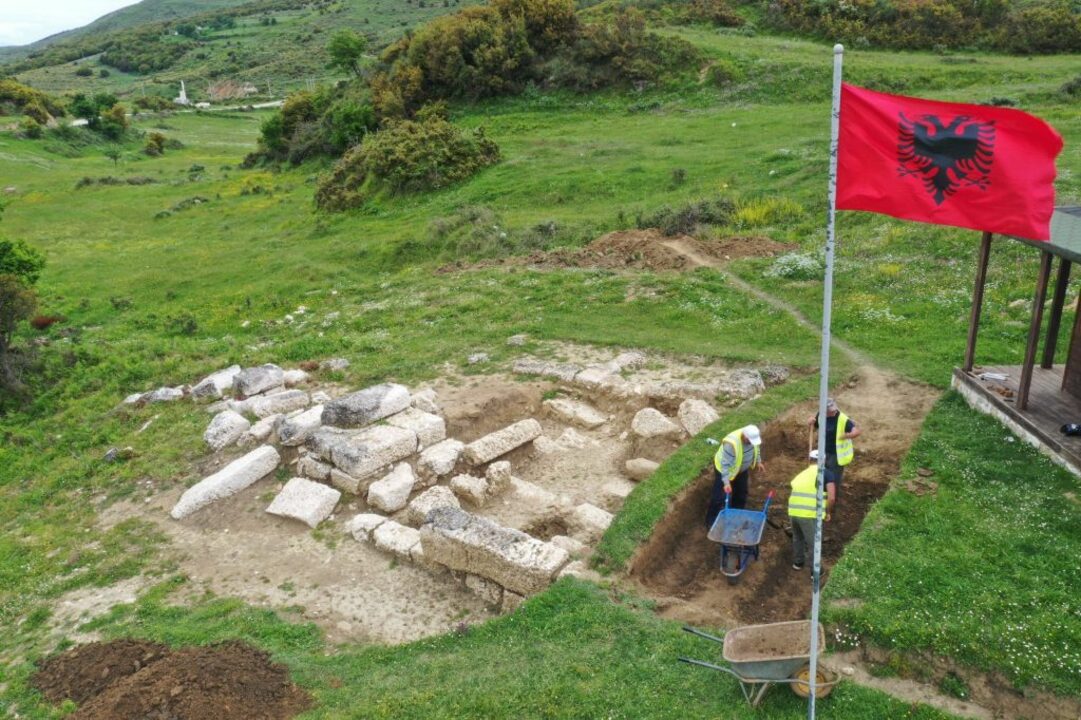
TIRANA, May 12 /ATA/ – Recent excavations at the Amantia Archaeological Park – an ancient Illyrian city site near Ploçë in southern Albania district of Vlora – have uncovered new traces of ancient life, including fortification walls and building remains dating from the 3rd century BC to the 6th century AD.
The discoveries were made during 2025 excavations on the site’s eastern terrace, where archaeologists are investigating a fortified structure that continues to reveal previously unknown aspects of the ancient city.
Minister of Tourism, Culture and Sports, Blendi Gonxhja, said on Tuesday the latest excavations, carried out by the National Institute of Cultural Heritage and the Regional Directorate of Cultural Heritage in Vlora, were shedding new light on the history of Amantia.
“The uncovered structures, dating from the 3rd century BC to the 6th century AD, demonstrate the continuity of life and the importance Amantia held through the centuries,” Gonxhja said.
Among the most significant findings is the foundation of an ancient building believed to have served a pastoral or livestock-related function, according to preliminary assessments. Evidence of the site’s reuse in modern times also suggests the area remained connected to human activity over a long period.
Gonxhja said each newly uncovered structure and artefact represented “living testimony” to Albania’s cultural heritage and brought researchers closer to understanding the country’s past.
Amantia, founded at the end of the 5th century BC in the Labëria region of southern Albania, was built on a hilltop and protected by fortified walls. The city expanded economically during the 3rd century BC and began minting its own coins, including currency issued in 268 BC.
Remains of the ancient Temple of Aphrodite, as well as the city’s theatre and stadium, are still visible today.
/k.s/r.e/u.sh/