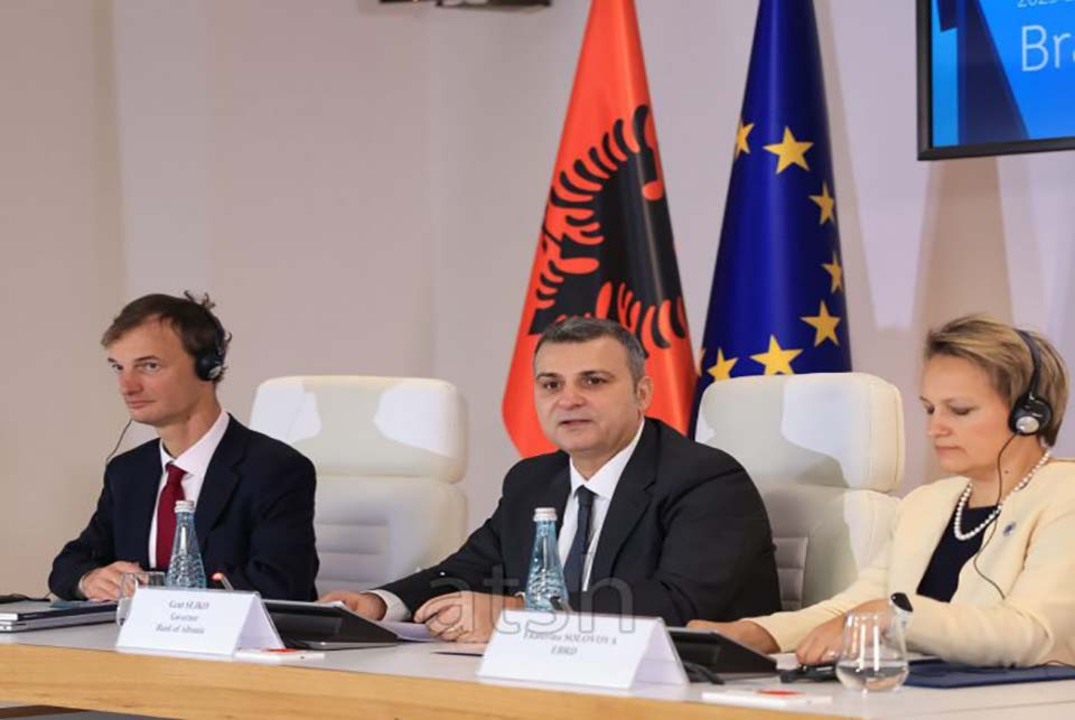
TIRANA, January 27/ATA/ Governor of the Bank of Albania Gent Sejko stated that the Albanian economy has demonstrated remarkable resilience, anchored by low inflation, steady growth, and robust labor markets.
Speaking at presentation event of the European Bank for Reconstruction and Development (EBRD) transition report 2025–2026 in Tirana, Sejko emphasized that labor market strengthening is marked by historic low unemployment and superior productivity relative to the global pre-crisis period, while demographic pressures have been alleviated by a rise in labor force participation.
“Despite this achievement, negative demographic trends in Albania are expected to persist. Our research shows that these trends are likely to exert downward pressure on real interest rates. This environment limits the effectiveness of conventional monetary policy; as low interest rates leave central banks less room to stimulate the economy. At the same time, demographic changes can also complicate inflation dynamics. Our research shows that the increase in the labor market participation rate comes as a result of higher wages,” said Sejko.
According to him, these findings confirm the broader conclusions of the EBRD transition report.
According to the Governor, the 2023 census data show that Albania has about 2.4 million inhabitants, while the population's median age has approached 43 years. While emigration, once a mitigating factor for unemployment, is increasingly becoming a structural challenge for the economy and society.
Sejko positively assessed the role of the Bank of Albania’s monetary policy in maintaining price stability and protecting purchasing power.
He emphasized that addressing demographic challenges requires bold reforms in pension systems, labor market adaptation, the design of sustainable migration policies and investments in the well-being of an aging population, including the use of new technologies and artificial intelligence, with a particular focus on younger generations in the economic decision-making process.
In conclusion, Sejko stressed that demography is a starting point, not a destiny and called for bold reforms, including pension reform, modernizing the labor market, realistic migration policies and investments in technology and artificial intelligence, with younger generations at the center of economic decision-making. /e.xh/j.p/p.s./