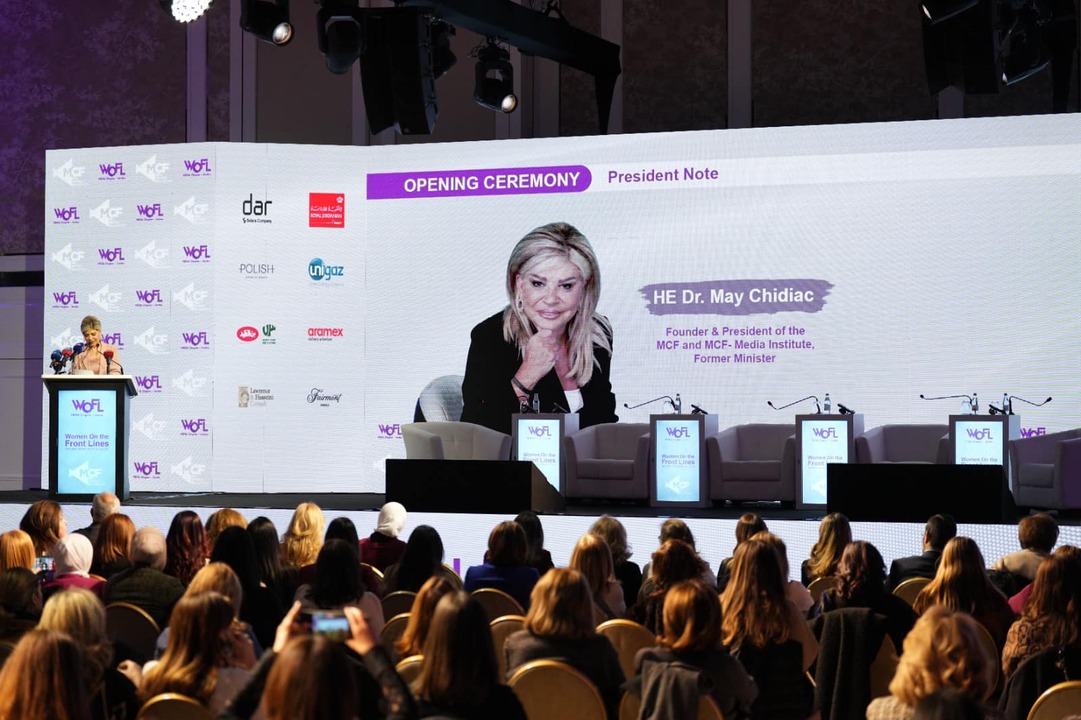
NNA - The May Chidiac Foundation – MCF Media Institute organized its 12th annual “Women on the Front Lines” (WOFL) conference on Wednesday, November 12, 2025, in collaboration with UN Women, under the Patronage and in the presence of H.E. Mr. Nawaf Salam, Prime Minister of Lebanon, and the First Lady of Lebanon, Mrs. Nehmat Aoun.
The conference addressed several key topics, most notably the revival of women’s roles in Lebanon and the Arab world, continuing a tradition of celebrating inspiring female figures who have overcome challenges and made tangible impacts across politics, diplomacy, business, technology, and media.
Now in its 12th edition, Women on the Front Lines once again aimed to ignite essential discussions on ways to strengthen women’s presence as key actors in politics, the economy, and the media. The event explored how female leadership can drive institutional reform, the importance of narrowing the digital divide to achieve gender equality, and the contribution of women entrepreneurs to digital transformation. It also examined how media and elections influence national policymaking—affirming that empowering women across these fields is fundamental to building a more equitable and sustainable society.
The conference was hosted by Youmna Naufal, Director of APCO Institute.
Opening remarks were delivered by H.E. Dr. May Chidiac, Founder & President of MCF and MCF-Media Institute, and Former Minister of State for Administrative Development, who welcomed attendees and expressed her appreciation for the presence and patronage of the Prime Minister, as well as the First Lady and all distinguished guests. She emphasized the importance of women’s participation in leadership and in driving social and political change.
Dr. Chidiac reaffirmed that this conference underscores women’s vital role in national renewal and her belief in the partnership between men and women in shaping change in an increasingly complex world. She highlighted Lebanon’s resilience despite recent crises, stressing the need to rebuild institutions and combat corruption and division. “Women’s participation,” she said, “is not a matter of representation but a precondition for national renewal and long-term stability.”
Next, Gielan Elmessiri, UN Women Representative in Lebanon, addressed the audience, emphasizing that women’s participation in decision-making positions is not a luxury but a cornerstone of stability. She noted that research consistently shows that women’s leadership contributes to more inclusive and just societies and that the private sector plays a vital role in creating job opportunities and fostering institutional trust based on equality and fairness.
The Patronage Note was delivered by H.E. Mr. Nawaf Salam, Prime Minister of Lebanon, who paid tribute to pioneering Lebanese women, recognizing their lifelong advocacy for women’s rights and political participation. He highlighted that women currently hold only 8 seats out of 128 in the Lebanese Parliament (6.3%), compared to a global average of 26%, and that only 27.5% of Lebanon’s labor force is female. Moreover, women represent over 80% of digital violence victims in Lebanon. He emphasized that empowering women politically and institutionally is not a favor but a national necessity, calling for comprehensive reforms and gender-responsive legislation.
A video report followed, showcasing MCF’s achievements since its founding—symbolizing resilience, innovation, and the promotion of democracy, freedom of expression, and women’s empowerment. The report also traced the evolution of the WOFL conference since its inception in 2013 in Beirut, its expansion to Jordan, and its return to Lebanon in 2025 as a fully in-person event carrying a message of hope, unity, and empowerment.
The first panel discussion, titled “Not Just a Seat: Women Politicians Driving Systemic Change”, focused on women’s capacity to influence social protection, education, healthcare, family policies, and gender-responsive budgeting. The session emphasized that by providing inclusive public services, women can reshape leadership around principles of equality, care, and sustainable social transformation.
The panel featured several distinguished speakers, beginning with the Minister of Social Development and Chairwoman of the Joint Ministerial Committee for Women’s Empowerment in the Hashemite Kingdom of Jordan, Her Excellency Wafa Bani Mustafa, who highlighted Jordan’s dual-track approach in this area. She said:
"We are working within two frameworks: the first is the graduation program, which targets families benefiting from the National Aid Fund. Its goal is to transition them toward sustainable employment opportunities through specific quotas in national employment programs and special codes in productive sectors. These codes sometimes even help correct historical injustices, by the way!"
Next, the Assistant Minister of Foreign Affairs for Human Rights Affairs in Kuwait, Her Excellency Sheikha Sheikha Jawaher Ibrahim Al-Sabah, expressed Kuwait’s unwavering commitment to women’s rights and equality for all citizens. She stated:
"The Constitution of Kuwait, in Article 29, clearly affirms the right to equality among all citizens. Based on this principle, subsequent legislation has been introduced to reinforce this right. Moreover, His Highness the Emir Sheikh Mishal Al-Ahmad is considered one of the strongest supporters of women’s rights in Kuwait."
The floor then passed to the Economic Advisor to the President of Egypt and former Minister of Planning and Economic Development, Her Excellency Dr. Hala El-Said, who stressed the importance of implementing national strategies for women’s empowerment. She said:
"In Egypt, our constitution affirms the status and rights of women. We have also developed the Women 2030 Strategy, which aligns with all pillars of Egypt’s Vision 2030. However, the key is not just developing strategies but implementing them on the ground. That is why we have begun working on gender-responsive budgeting, given that certain groups in society are differently affected by political and economic conditions."
Following her, the Minister of Social Affairs of the Syrian Arab Republic, Her Excellency Hind Kabawat, spoke optimistically about the future despite current challenges. She said:
"It is true that Syria has faced difficult circumstances, but today, God willing, we are moving toward overcoming this challenging phase. We are currently preparing a new law to combat hate speech, as it threatens relationships between peoples and weakens the social fabric."
The interventions concluded with the Minister of Social Affairs in Lebanon, Haneen Sayyed, who highlighted the importance of building a comprehensive vision for social protection. She said:
"When we assumed the ministry, we began focusing on social protection and securing the necessary funding. Through my previous experience at the World Bank, I learned that we must always start with a clear vision, then determine the priorities, policies, and programs needed to achieve it."
The discussion was moderated by His Excellency Dr. Ziad Baroud, lawyer and former Minister of Interior and Municipalities, who emphasized the importance of women’s leadership in decision-making and their vital role in promoting social justice and sustainable development in their communities.
A fireside talk was then held with Dr. Hajar Haddaoui, Director-General of the Digital Cooperation Organization, under the title “Navigating the Digital Divide: Leadership for a Connected Region”, addressing digital innovation and leadership across the Middle East and North Africa. She highlighted the importance of inclusive digital systems, empowering entrepreneurs, and driving economic growth, with a focus on collaboration between governments, the private sector, and civil society. The session was moderated by entrepreneur and founder of DxTalks and BCC Management, Rudy Shoushani.
Following this, Mr. Mohammad Naciri, Chief of Staff UN Women Headquarters, delivered a brief presentation on “Reclaiming Influence: Private Sector Leadership Beyond the Table.”
The second panel, titled “Business Digitalization: Women Entrepreneurs Leading E-Commerce Initiatives,” focused on Lebanese women reshaping the e-commerce landscape through innovation and inclusive entrepreneurship across fintech and other sectors. The discussion highlighted their journey in overcoming challenges, seizing opportunities, and leveraging digital platforms to support economic growth and women’s empowerment.
Participants included:
● Dr. Kamal Shehadi, Minister of State for Technology and Artificial Intelligence and Minister for the Displaced, who said:
"We are working on a national plan for artificial intelligence and personal data protection—a project that began over thirteen years ago—and we are now advancing it as the importance of this work is increasingly recognized. We are also creating new jobs aligned with the digital transformation, and we hope everyone assumes responsibility in this field. Lebanon has the opportunity to become what we envision, with the ability to play a pivotal role in the Arab world across health and technology sectors."
● Maya Ayoub, Founder and CEO of District Twelve and National Director for Women in Tech®️ Global in Saudi Arabia, highlighted the dramatic rise of women in technology in Saudi Arabia:
"In 2017, women’s representation in the technology sector was under 7%. Today, in 2025, it has reached around 35%, surpassing global averages."
● Beindy Dagher, Program Director for Good Governance and Anti-Corruption at the EU Delegation in Lebanon, emphasized the role of digitalization in enhancing transparency and combating corruption.
● Fadi Dou, CEO of MultiLane, underscored technology as a driver of job creation, aiming to generate over 10,000 jobs in collaboration with international partners.
● Nizar Hneini, Managing Director and Head of Digital Services at Roland Berger Middle East, stressed investing in social and knowledge capital to enhance Lebanon’s regional position in digital transformation.
The session was moderated by Antoine Saadeh, television presenter and economic analyst at MTV.
The third panel, “Reclaiming Influence: Private Sector Leadership Beyond the Table,” explored how Lebanon’s private sector contributes to national priorities beyond traditional politics. Discussions highlighted how business leadership, strategic investment, and public engagement enable private actors to innovate platforms and redefine leadership in a divided nation.
Participants included:
● Dr. Amer Bassat, Minister of Economy and Trade, who outlined structural challenges in public-private cooperation and emphasized improving the legal and security environment to attract investment.
● Dr. Nabil Fahed, Vice President and Treasurer of the Chamber of Commerce and Industry in Beirut and Mount Lebanon, stressed creating a safe and attractive investment environment.
● Nadine Khoury, CEO of The Quinta Group, spoke on innovation in production sectors, particularly agriculture, and leveraging AI for efficiency.
● Mireille Korab Abi Nasr, real estate investment expert, highlighted the importance of involving the real estate sector in national urban planning.
● Bernard Tannoury, CEO of Benta Group, emphasized the private sector as the backbone of Lebanon’s economy.
● Emilie Wahab Harb, General Manager of L’Oréal Lebanon, reaffirmed the company’s commitment to invest in Lebanon despite challenges, citing the country’s talent and creativity.
The session was moderated by Lea Fayad, economic journalist and correspondent at LBCI.
The fourth and final panel, “Media and Politics: Drivers of Change in National Politics,” brought together media and political leaders to discuss the role of journalism in Lebanese elections and shaping public opinion. The session examined how media contributes to electoral awareness, voter behavior, and the democratic responsibilities of journalists.
Speakers included:
● H.E. Dr. Paul Morcos, Minister of Information, who reaffirmed his long-standing support for women’s participation in public life and outlined reforms to modernize media regulation.
● Walid Abboud, Editor-in-Chief of MTV Lebanon, stressed equality in media coverage based on competence rather than gender.
● George Saliba, News Director at Al-Jadeed, highlighted the need for effective participation of women in politics beyond symbolic representation.
● Judge Nazek Al-Khatib, Chair of the Legal Committee at the National Commission for Lebanese Women, presented data showing women’s limited political representation (6.2% in parliament) and the need for electoral reforms.
● Dima Abou Daya, Member of Zahle Municipal Council, emphasized implementing women’s quotas at the local level.
● Melissa Maatouk El Adem, Member of Jounieh Municipal Council, highlighted the positive role of media in supporting women candidates during elections.
The discussion was moderated by Fadi Chahwan, TV presenter at MTV Lebanon.
The Women on the Front Lines – Lebanon 2025 conference concluded with a closing address by Carmen Nohra, Senior Public Policy Consultant, who summarized the recommendations from the series of sessions:
“Lebanon’s recovery, future, and prosperity will be richer, stronger, and fairer when Lebanese women are included—not as a charitable act, but as a genuine opportunity for growth and development. Let us transform today’s achievements into sustainable programs, jobs, and initiatives for the future.”
Participants departed the event praising the intellectual and humanitarian value of the sessions, the high-quality organization, and the content. Attendees expressed enthusiasm for the 2026 edition, emphasizing that strengthening women’s roles remains central to building a more prosperous and just Lebanon and region.