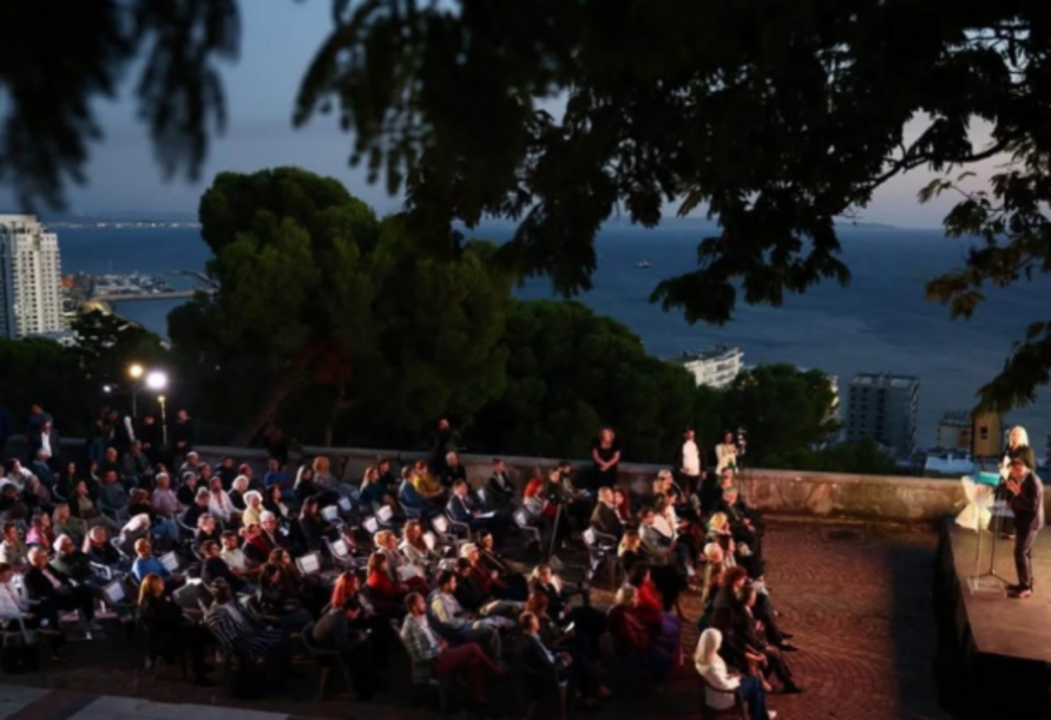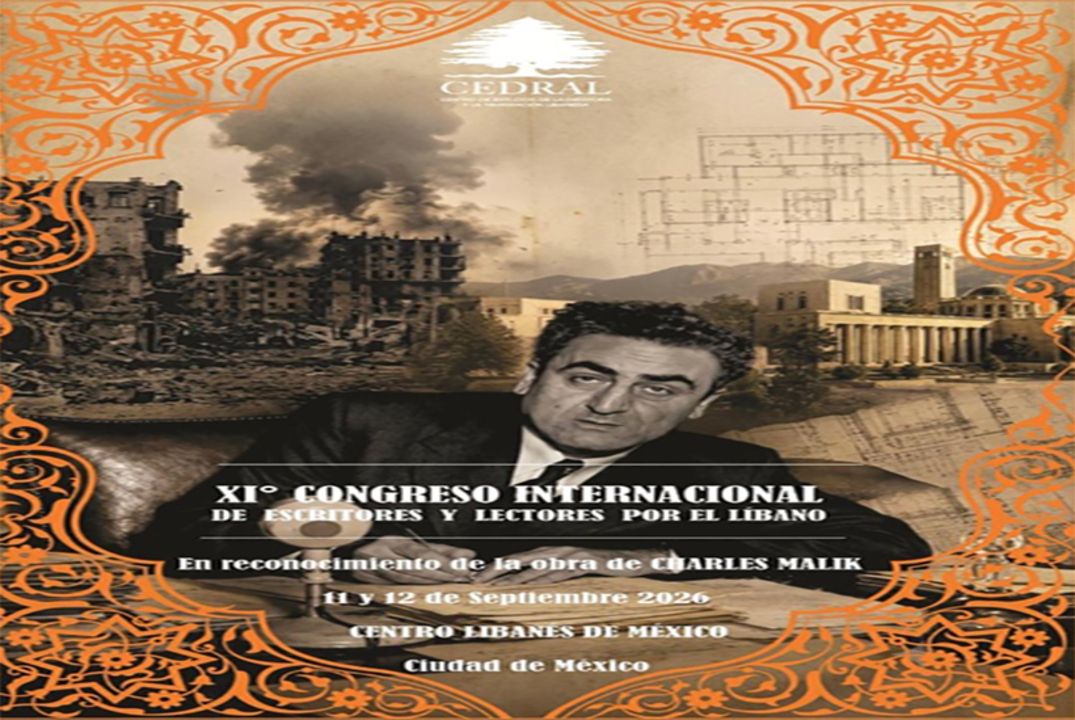
NNA - The "Center for Studies on Lebanese Diaspora and Migration" CEDRAL organized, in the Mexican capital Mexico City, the "11th International Conference of Writers and Readers for Lebanon", in cooperation with the "Lebanese Center" in Mexico, with the participation of delegations from Lebanon, Argentina, Colombia, Dominican Republic, Mexico, the United States and several countries in Latin America, at the "Lebanese Center" in Mexico, in an event described as "a first-class diplomatic, academic and cultural bridge between Lebanon and the diaspora in Latin America", according to CEDRAL President Dr. and researcher Walter Muller Moujir, whose center works to preserve Lebanese cultural heritage in Latin America and is headquartered in Argentina.
The conference included a special tribute to the late Lebanese Ambassador and thinker Charles Malik, on the occasion of the 120th anniversary of his birth and in appreciation of his role in the Universal Declaration of Human Rights 1948.
*Message from the Minister of Culture*
The President of CEDRAL indicated that he "received a message from Minister of Culture Ghassan Salameh greeting the conferees, and thanking the Center and all its partners for their commitment to keeping Lebanese culture alive outside the borders of our homeland Lebanon".
Salameh said in his message: "This gathering is more than just a literary event, it is a bridge between Lebanon and the diaspora, it is a space where memory and languages meet to tell our history. And you, by bringing together voices from Lebanon and the world, contribute to preserving a cultural heritage that transcends distances and to rediscovering a country through its words, so that Lebanese culture becomes a universal language of dialogue, memory and creativity".
The opening ceremony was attended by Lebanon's Ambassador to Mexico Dr. George El Jallad, Chairman of the Board of the Lebanese Center Dr. Jorge Serio Salomon, and Director of Cultural Events at the Center Engineer Wassim Mobeid, alongside heads of Lebanese institutions in Mexico, writers, authors, members of the World Cultural Union and a delegation of Lebanese youth.
*President of the Center*
The conference began with a welcoming speech by the President of the Center in which he said: "This conference is a bridge between Lebanon and its diaspora, where word, memory and identity meet. Despite the pain and the conditions Lebanon is experiencing today, our message is one: when history breaks, the Lebanese people turn into a poem... a poem written by Gibran, Naimy, Said Akl, Sabah, Fayrouz and Charles Malik, and written today by each one of you". And he concluded: "When everything fades away, words resist and move us and question us... Today it is our turn to be a poem".
*Ana Cecilia Juri Feghali*
Colombian writer of Lebanese origin Ana Cecilia Juri Feghali presented a moving testimony entitled "Unity of War" representing her roots and her experience as a witness to the reality of her ancestors' land, and paused at the memory of the great Lebanese thinker Charles Malik describing him as "proof that Lebanon is not just a geography, but an idea and a universality", and said: "We cannot but express pain and concern over the harsh reality Lebanon is experiencing today. But I want you to be convinced that when history breaks, and when words betray us, the Lebanese people turn into a poem".
She addressed the duality of uprooting and return, describing the homeland as "a riddle of eighteen prayers, a labyrinth of painful contradictions, where planes fly over the sky of the South and the Bekaa... and memory", and said: "I left behind the footsteps of my beloved city Cali, the scent of sugar cane and the evening breeze, to inhabit the land of my ancestors, where today maps are torn under the sky of Beirut".
She continued: "Lebanon today is a shrine of identities gathered in one geography, but divided by memory. Its true tragedy does not lie in the diversity of its 18 sects, but in the closure of their narratives, a country that has learned how to share place not time, where each community guards its own truth, sings its own anthem and mourns its own martyr".
And she concluded: "The true Lebanon is not built of empty stones; it is built of human beings under fire... Distance may erase paths, but it will never erase the memory of blood".
Participants affirmed that "such meetings prove that despite distances and difficult stages, the ties between Lebanon and its diaspora in Latin America remain alive, solid and vibrant through literature and culture".
The sessions of the first day focused on "building migrant identity, the Phoenician heritage, Charles Malik's thought on the right to narrate identity, in addition to readings in the literature of Gibran Khalil Gibran. Interventions included topics on the red tarboush, and the Jose Helu Chair for Arabic Language and Culture at El Colegio de México.
The sessions of the second day dealt with literature and geopolitics, alongside interventions on the history of Lebanese families from Tripoli to Yucatan, the legacy of the Younes family, poetry of emigration over the cedars of Lebanon, Lebanon as a victim of geopolitical conflicts, contributions of Mexican doctors of Lebanese origin, and war memoirs 1914-1918.
The conference concluded with the announcement of recommendations calling for "the creation of a network of Lebanese diaspora writers, the launch of the Charles Malik Prize for Thought, and the organization of the twelfth edition in Beirut in 2028 if security conditions allow".
The President of the "Lebanese Center" in Mexico Dr. Salomon said at the conclusion of the conference: "This conference proved that the Lebanese Center in Mexico is a fortress of all-embracing Lebanity, and that the word is our most enduring weapon".
Certificates were distributed and a special tribute to the late Charles Malik and a number of diaspora figures, and everyone participated in a dinner on the occasion of the 16th anniversary of the founding of CEDRAL, amid a collective call "for peace in the homeland of the cedar and that culture remains the bridge for peace in Lebanon".
The Center indicated in a statement that "the Conference enjoyed the support of a wide network of the Embassy of Lebanon in Mexico, the Lebanese Ministry of Culture, the Lebanese Center in Mexico, the National Gibran Committee in Bcharre, UNAM University, University of Texas, and the National University of Rosario, and universities from Lebanon, Brazil, Argentina and Mexico".
The conference formed "an international platform bringing together writers and researchers of Lebanese origin around the world to document the historical memory and literary production of the global Lebanese community".