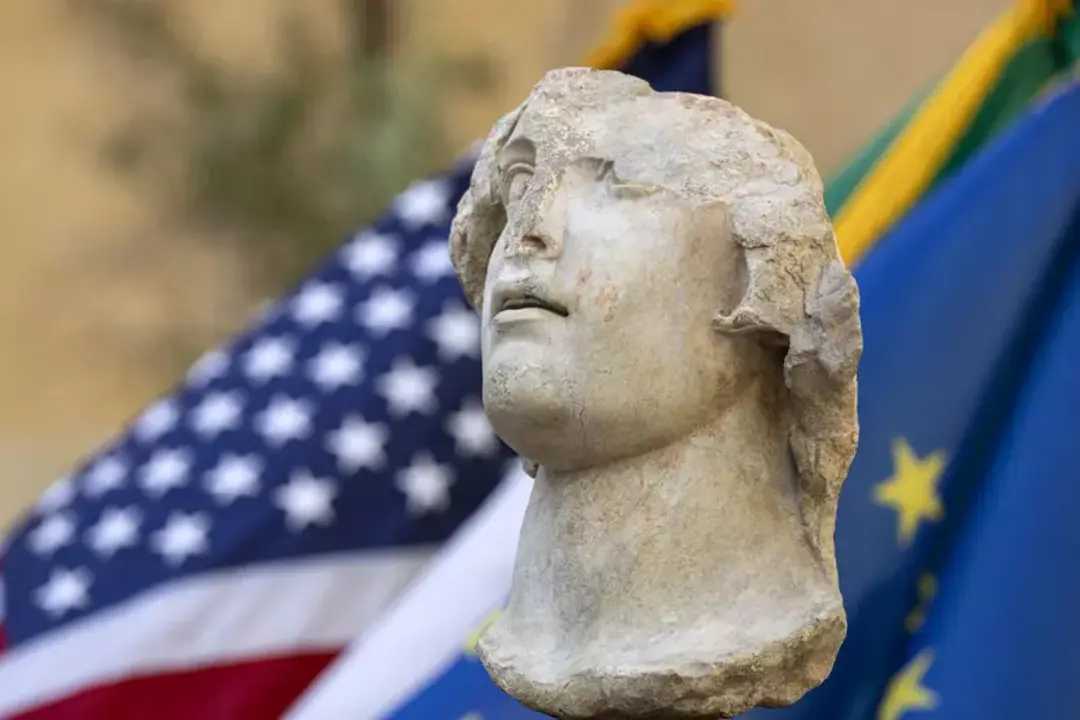
Italian art cops on Wednesday evening unveiled some 337 ancient artifacts that have been returned to Italy from the United States over recent months including a marble head of Alexander the Great from the Roman Forum.
Hailing the operations, Culture Minister Alessandro Giuli said "our culture will not be lost".
A total of 337 objects, mostly Roman archaeological finds such as the head of Alexander the Great from the Basilica Aemilia in the Roman Forum, but also Byzantine and Magna Graecia artifacts, works of art, and archival materials, largely from clandestine excavations or stolen from institutions: these are the cultural assets repatriated from the United States and presented at the headquarters of the Carabinieri operational unit for the protection of Cultural Heritage, Caserma La Marmora, in the presence of Giuli and the United States Ambassador to Italy, Tilman J.
Fertitta.
The repatriation of the works, which are the result of recovery operations completed between last December and April 2026, as emphasized by Carabinieri TPC Commander General Antonio Petti, is the result of a concerted operational strategy without which it is impossible to combat "a global and complex phenomenon" like international art trafficking.
Of the 337 repatriated assets, 221 were returned thanks to collaboration with the Manhattan District Attorney's Office, while the remaining 116 were recovered on April 10 through the joint efforts of the Federal Bureau of Investigation, Homeland Security Investigations, the District Attorney's Office, and, in one case, with the contribution of Christie's New York auction house.
"Every time I'm around Carabinieri officers who work with cultural heritage, I feel at home," Giuli stated in his remarks, during which he expressed "deep and sincere thanks to the investigative authorities of the United States" and to the Carabinieri for their efforts to combat the trafficking of cultural heritage.
"Culture is not lost, it is not forgotten," he observed, "but rather it is protected, recovered, and, above all, returned to the community.
"These precious testimonies will now be studied, protected, and promoted so that they can return to their places of origin and be enjoyed by the public." Stressing that the restitution of the assets to Italy "is the result of a collaborative effort involving institutions, law enforcement, and experts from Italy and the United States," the minister assured that this is a commitment "that looks to the future: protecting our heritage means defending memory, strengthening identity, and transmitting to new generations the value of culture as a universal public good." On what marks the 25th anniversary of the "close collaboration between Italian and U.S.
law enforcement agencies, including the Carabinieri, Homeland Security Investigations, and the Federal Bureau of Investigation," U.S. Ambassador Fertitta explained that this partnership "reflects a shared commitment to protecting cultural heritage and combating illicit trafficking of artifacts. It represents a concrete example of what we can achieve together: preserving priceless treasures, ensuring respect for the rule of law, and strengthening the enduring bonds between the United States and Italy for future generations," he said.
Among the most significant finds, in addition to the marble head of Alexander the Great depicted as Helios (1st century AD), are a bronze sculpture looted from Herculaneum and two Egyptian basalt sculptures.
The core of the returned works also includes a selection of artifacts dating from the 5th century BC to the 3rd century AD, including sculptures, bronzes, ceramics, and goldwork.
The group recovered with the Federal Bureau of Investigation includes bronzes and terracottas from the Iron Age to the Hellenistic period, while the assets returned with the assistance of Homeland Security Investigations include a ship's rudder, a Canosa vase, and a set of Roman coins.
Among the assets is "the 1524 letter from Alfonso I d'Este to poet Ludovico Ariosto: a document that will finally be returned to its original context, at the State Archives of Massa, reconstructing the unity of a heritage and restoring the full meaning of the sources," emphasized Antonio Tarasco, Director General of the Archives.
"It is also thanks to these operations," he concluded, "that the Archives strengthen their function: preserving and transmitting over time authentic testimonies, essential for a full understanding of our history and our institutional order."
ALL RIGHTS RESERVED © Copyright ANSA