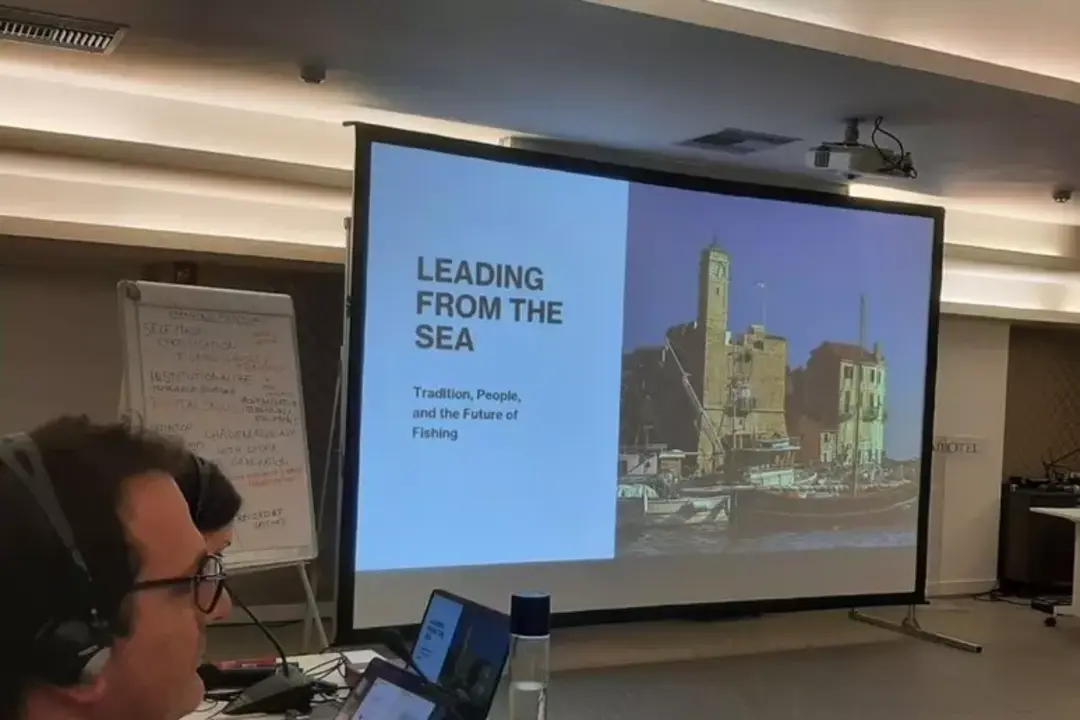
How can young people be attracted to fishing, while at the same time involving them in an activity that is environmentally and economically sustainable and that supports small-scale fisheries (SSF)? These were the questions posed at a forum of young fishers from the Mediterranean and the Black Sea organized by the General Fisheries Commission for the Mediterranean (GFCM - the regional fisheries management organization operating under the FAO) together with WWF.
The two-day event in Athens brought together fishers from different countries—from Greece to Italy, from Croatia to Spain—along with several colleagues connected online from Tunisia, Morocco, Algeria and Egypt.
They discussed their working conditions and the major difficulties they face, including economic pressures, declining catches due to climate change, and much more, as well as the need to find innovative solutions to prevent the sector from sliding into agony. A turning point that must be driven by fishers themselves, observed Ignacio, a fisher from Motril in Andalusia: "The initiative must come from us fishers, because we know the sector, we know what is needed and the problems that need to be solved." According to GFCM statistics, small-scale fisheries account for 81% of the fishing fleet and activities in the Mediterranean and the Black Sea, making up a significant share of the sector.
Forty-seven percent of fishers are over 40 years old, while 17% are under 25. Many young fishers follow family traditions, but others have chosen the sector independently, attracted by the freedom it offers. The challenges, however, are numerous: unstable income, high costs, and harsh working conditions.
Regulatory constraints and climate change also weigh heavily.
"I got into fishing almost as a joke. My father wanted to buy a small fishing boat as an investment and suggested I try it out, but in the end I bought it myself. That's how I fell in love with it. I'd recommend fishing to everyone: apart from the early mornings and the cold, it's a beautiful job," says Elia, a fisher from Caorle in the Veneto region, who left university to go to sea. Many of his colleagues at the forum, however, boast fishing grandparents, and despite the adversities they are keen to stress how extraordinarily beautiful and engaging this work is.
"Another serious problem is recreational fishing, carried out by people who often fish illegally, sell their catch at rock-bottom prices, and don't pay taxes. Ten of them equal one professional fisher," says Stavros, a fisher from Mytilene on the island of Lesbos. In Greece alone there are tens of thousands of recreational fishing activities. Recreational fishing is regulated in most countries; however, poor enforcement of the rules encourages illegal practices that create unfair competition for professional small-scale fisheries. Some women fishers—such as Simone from the Black Sea coast in Bulgaria—described how they joined the family business after initial reluctance. "At first I regretted leaving my studies, but then I became passionate about fishing. And I also came to understand the difficulties of this world." From Morocco, Safae explains that "women are marginalized; people don't trust us. We want to create positive change from the ground up. Because the income from this sector is important for us and for the economy.
Women and young people need to work together." The possible solutions for the small-scale fisheries sector that emerged in Athens were many, and the exchange among fishers was passionate and lively, with everyone bringing their own experience, national issues and shared challenges. Antonia, from Kefalonia in Greece, who is trained as an agronomist, explains how she turned to fishing tourism: "To continue being fishers, it was the only way." And for Miguel Angel from Palma de Mallorca, "challenges can become opportunities. Take the blue crab, for example: if we start selling it, turning it into a profit, if a famous chef creates a recipe with it, then it becomes a source of income." Everyone agrees that meetings like this are invaluable: "We hear about problems faced by colleagues in other countries that we may have solved years ago, and vice versa, and we can represent a solution," adds Ignacio. "Fish stocks are declining, and this is not just an overfishing problem; it is linked to rising water temperatures," says Antonis, from Cyprus. "Alien species are arriving, first of all in the eastern Mediterranean. For example, temperatures of 26-27 degrees recorded at fifty meters depth in October are summer temperatures. Twenty years ago they were 22-23. Speaking of threats and solutions: there is the rabbitfish, which breaks nets and eats the catch. Fishers catch it and sell it to the government, which pays five euros per kilo and then burns it. That's a subsidy-based solution. With lionfish, you just need to remove the venomous spines and it can be marketed and cooked. You just have to overcome people's reluctance—they only think about the venom and worry." There were also video contributions from the southern shore, with fishers such as the Moroccan Safae and the Tunisian Chorouk describing how the challenge for women is even greater, as is their determination.
Other tools can include training, digitalization of the sector, the ability to use social media to tell the story of daily life at sea, managing fishing in a sustainable way, and above all networking—creating associations that can make the voices of young fishers heard by national authorities and at the European level. The idea emerged of writing a letter to the European Commissioner for Fisheries, Costas Kadis, to convey the voices of young fishers and their innovative ideas, to ensure that a crucial activity—with its economic, food and social implications—in the Mediterranean and beyond can have a future.
ALL RIGHTS RESERVED © Copyright ANSA